
Icebreaker
• Angela, a 43-year-old woman, belonged to one of the newer Christian churches and had been married for sixteen years without a child.
• Throughout those years, she experienced neither pregnancy nor miscarriage.
• As time passed, pressure mounted from her husband’s family.
• Eventually, her husband warned that if she did not conceive before the end of the year, he would take another wife.
• Brokenhearted and overwhelmed, Angela confided in her colleague and friend, Rose, who was a devoted Catholic.
• Rose gently encouraged her to entrust her pain to the Blessed Virgin Mary by praying the Holy Rosary.
• Although hesitant at first, Angela eventually visited Rose’s parish priest.
• The priest encouraged her to pray the Rosary faithfully, visit the Marian grotto, and deepen her trust in Christ through the intercession of His Mother. He also gave her a Rosary and a prayer book.
• Reluctantly and quietly, Angela began praying the Rosary and visiting the grotto.
• Three months later, she conceived.
• Nine months afterwards, she joyfully gave birth to healthy twins—a boy and a girl.
• Deeply moved by what she believed to be Mary’s powerful intercession, Angela and her husband embraced the Catholic faith and she has since shared her testimony with many others.
• But does the Rosary truly possess miraculous power? And what exactly does the Church teach about the Blessed Virgin Mary and devotion to her?
Is the Bible the Only Source of Christian Faith?
Cecilia’s experience reflects one of the most common questions Catholics face today: “Is it in the Bible?” Behind this question lies the doctrine popularly known as sola Scriptura (“Scripture alone”), which maintains that the Bible is the sole rule of Christian faith and practice.
There is no doubt that the Bible is the primary and authentic source of Christian teaching and morality. It is both authoritative and normative—the norm that informs every other norm while itself remaining the supreme written standard of divine revelation.
However, the claim that Christians need only the Bible is itself not found anywhere in Scripture.
In fact, Sacred Scripture itself teaches otherwise. St. John concludes his Gospel by saying:
“There are also many other things which Jesus did; were every one of them to be written, I suppose that the world itself could not contain the books that would be written.” (Jn. 21:25)
This tells us that not everything Christ taught or did was written down.
Furthermore, many ordinary aspects of Christian life are nowhere explicitly commanded in Scripture. The Bible does not specifically command Christians to attend schools, build hospitals, or use modern technology, yet Christians rightly embrace these realities because they do not contradict God’s revealed truth.
Therefore, the question is not simply whether something is explicitly written in the Bible, but whether it faithfully belongs to the deposit of faith handed down by Christ and His Apostles.
What Is the Deposit of Faith Entrusted to the Church?
As Cecilia searched for answers, she discovered that the Catholic Church speaks of the Deposit of Faith (depositum fidei), a treasure entrusted by Christ to the Apostles and faithfully handed on through the centuries.
St. Paul exhorts Timothy:
“Guard the good deposit entrusted to you.” (2 Tim. 1:14)
The Bible itself forms an essential part of this sacred deposit, but it is not its entirety.
The Scriptures are the inspired written Word of God (Scriptura), yet from the very beginning the Apostles also transmitted many teachings orally before they were ever written down.
The Bible itself reminds us of this reality.
St. Paul commands the Thessalonians:
“Stand firm and hold to the traditions which you were taught by us, either by word of mouth or by letter.” (2 Thess. 2:15)
Likewise he instructs Timothy:
“What you have heard from me before many witnesses entrust to faithful men who will be able to teach others also.” (2 Tim. 2:2)
The early Church also devoted itself to:
“The apostles’ teaching and fellowship.” (Acts 2:42)
Thus the Church safeguards what Christ entrusted to her—not merely written texts but the fullness of apostolic teaching faithfully preserved throughout history.
How Do Sacred Scripture, Sacred Tradition, and the Magisterium Work Together?
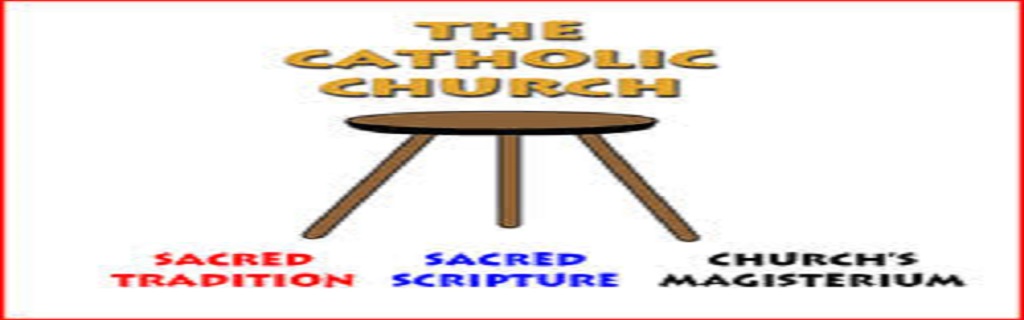
One of the greatest discoveries Cecilia made was that Catholic teaching rests upon three inseparable pillars:
- Sacred Scripture
- Sacred Tradition
- The Magisterium
Sacred Scripture is the inspired written Word of God (2 Tim. 3:16–17).
Sacred Tradition consists of the living teachings, worship, practices, and doctrines handed down from the Apostles before and alongside the written Scriptures (1 Cor. 11:23; 2 Thess. 2:15; CCC 76, 80–82, 85–87, 97, 100).
The Magisterium is the Church’s living teaching authority exercised by the Pope and the bishops in communion with him. Christ entrusted this authority to the Apostles when He declared:
“You are Peter… I will give you the keys of the kingdom of heaven.” (Mt. 16:18–19)
The Second Vatican Council, in Dei Verbum, beautifully teaches that Scripture and Tradition are like two streams flowing from the same divine source. They belong together like the two sides of one coin, while the Magisterium faithfully preserves, interprets, and safeguards both.
The Church therefore does not stand above God’s Word but serves it faithfully.
Can the Catholic Church Be Trusted to Preserve the Truth?
The criticisms Cecilia encountered caused her to wonder whether the Church herself could have gone astray over the centuries.
Catholic faith answers this concern with confidence rooted in Christ’s own promises.
The Church is Mother and Teacher (Mater et Magister), entrusted with preserving the truth of the Gospel.
This does not mean every Christian, bishop, priest, or pope is personally free from sin or incapable of making mistakes in ordinary matters.
Rather, it means that the Church herself is protected by Christ from falling into doctrinal error in matters of faith and morals. This divine protection is known as indefectibility.
Jesus Himself promised:
“The gates of hell shall not prevail against it.” (Mt. 16:18)
and again:
“I am with you always, to the close of the age.” (Mt. 28:20)
Likewise He declared:
“He who hears you hears me.” (Lk. 10:16)
Within this context the Church also understands papal infallibility. When the Pope speaks ex cathedra on matters of faith and morals, he is preserved from teaching error—not because of personal holiness or superior intelligence, but because Christ protects His Church from doctrinal deception.
Thus, while certain Catholic doctrines may initially appear difficult or unfamiliar, careful study consistently reveals their biblical foundations, whether directly or indirectly.
How Should Catholics Respond When Their Faith Is Challenged?
Instead of abandoning her faith, Cecilia’s questions became an invitation to deeper study.
The same should be true for every Catholic.
Not understanding a doctrine should lead us, not to despair, but to prayer, study, and humble inquiry.
Mysteries are not obstacles to faith; they are invitations to deeper reverence before God’s infinite wisdom.
The Church therefore cautions against purely private interpretations of Scripture.
As St. Peter teaches:
“No prophecy of Scripture is a matter of one’s own interpretation.” (2 Pet. 1:20)
Rather than relying solely upon personal opinion, Catholics are encouraged to learn from the Church that received, preserved, and transmitted the apostolic faith throughout the centuries.
Every Catholic should also be prepared to explain and defend the faith with both conviction and charity.
St. Peter encourages believers:
“Always be prepared to make a defence to anyone who calls you to account for the hope that is in you, yet do it with gentleness and reverence.” (1 Pet. 3:15)
Authentic apologetics seeks not to win arguments but to bear witness to the truth in love.
How Can Catholics Grow in the Deposit of Faith Every Day?
Cecilia eventually realized that defending the faith requires more than possessing arguments. It requires a living relationship with Christ.
The best way to understand Scripture is to approach it prayerfully.
The Bible is not merely a historical or scientific textbook. It is God’s inspired Word expressed in human language—a divine love letter revealing His plan of salvation.
God speaks to us through the Scriptures.
We respond to Him through prayer.
This encounter reaches its highest expression in the Holy Mass, where the Liturgy of the Word prepares believers to receive Christ Himself in the Holy Eucharist.
As St. Jerome famously reminds us:
“Ignorance of the Scriptures is ignorance of Christ.”
Yet knowledge alone is not enough.
The Deposit of Faith must not merely be studied; it must be lived.
Only when faith shapes our words, decisions, relationships, and witness do we truly become disciples of Christ.
Conclusion: Did Cecilia Find the Truth She Was Searching For?
Cecilia began her journey shaken by criticism and doubt.
The accusations on social media seemed convincing at first.
She wondered whether the Catholic Church had built its teachings upon human traditions rather than God’s Word.
But the more she studied, the more she discovered that the Catholic faith is firmly rooted in the Deposit of Faith entrusted by Christ to His Church—a treasure faithfully preserved through Sacred Scripture, Sacred Tradition, and the living Magisterium.
She came to understand that the Church did not invent the Bible; rather, the Church received, preserved, recognized, and faithfully handed it on to future generations under the guidance of the Holy Spirit.
Her doubts gradually gave way to deeper conviction.
Like Cecilia, every Catholic will eventually face questions about the faith.
Such moments need not become occasions for fear or uncertainty.
Instead, they can become opportunities to pray more deeply, study more faithfully, and trust more confidently in Christ, who continues to guide His Church.
For the Deposit of Faith is not merely a collection of doctrines.
It is the living truth of Christ entrusted to His Church for the salvation of the world.
May we therefore treasure Sacred Scripture, faithfully receive Sacred Tradition, confidently trust the Magisterium, and live the Catholic faith with knowledge, humility, charity, and unwavering conviction.